

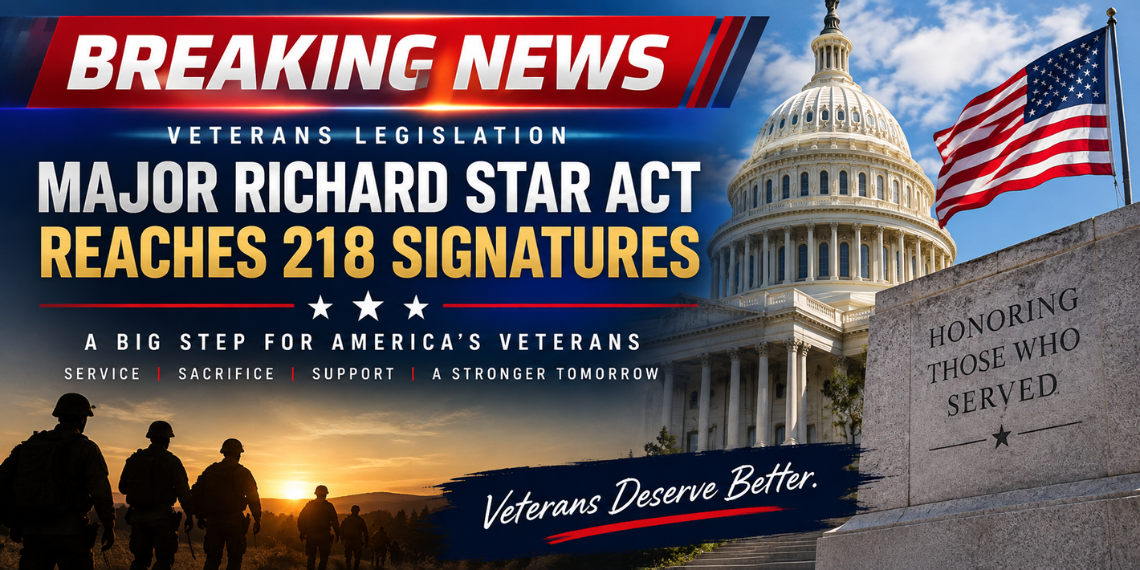
After months of advocacy, the effort to force House consideration of the Major Richard Star Act reached a major procedural milestone Tuesday, September 15, when Discharge Petition No. 22 secured its 218th signature.
U.S. Representative Nancy Mace of South Carolina became the 218th Member of Congress to sign the petition, providing the absolute majority required under House rules to advance the discharge process. The official Office of the Clerk of the U.S. House of Representatives lists Mace as signature No. 218, dated September 15, 2026.
For veterans and advocates who have spent years pushing for passage of the Major Richard Star Act, reaching 218 is significant. But it is important to understand what Tuesday’s milestone does [and does not] mean.
The bill has not passed the House. A House vote has not yet occurred. And reaching 218 signatures does not automatically place the legislation on the floor immediately.
Instead, the discharge petition has cleared one of the most difficult procedural hurdles standing between the Major Richard Star Act and consideration by the full House.
What Is the Major Richard Star Act?
The Major Richard Star Act, H.R. 2102, would change federal law governing the concurrent receipt of military retired pay and Department of Veterans Affairs disability compensation for certain veterans medically retired because of combat-related disabilities.
Under existing law, military retirees generally cannot receive military retired pay and VA disability compensation simultaneously without an offset unless they qualify for one of the existing statutory exceptions. The Congressional Budget Office notes that Concurrent Retired and Disability Pay and Combat-Related Special Compensation already provide exceptions for certain retirees, but restrictions remain, particularly for Chapter 61 disability retirees.
H.R. 2102 would change those rules for qualifying disability retirees with combat-related disabilities, allowing them to receive their military retirement pay without the reduction currently associated with receiving VA disability compensation. The official bill text describes its purpose as providing for the concurrent receipt of veterans’ disability compensation and retirement pay for disability retirees with combat-related disabilities.
The issue has remained before Congress for years and has attracted substantial bipartisan support; however, such broad support for legislation does not necessarily guarantee that legislation will receive time on the House floor.
That reality is precisely why supporters turned to the discharge petition.
What Is Discharge Petition No. 22?
A discharge petition is a rarely successful House procedure that allows Members to attempt to bring legislation to the floor when it has not otherwise advanced through the normal committee and leadership process.
Discharge Petition No. 22 was filed May 21, 2026, by Representative Mark Takano of California. Technically, the petition seeks to discharge the House Committee on Rules from further consideration of H.Res. 1247, a special rule providing for consideration of H.R. 2102, the Major Richard Star Act.
That distinction matters.
The petition is not directly discharging H.R. 2102 from committee. Instead, it targets the resolution that would establish the procedure for bringing H.R. 2102 before the House.
Under House Rule XV, a discharge petition requires signatures from a majority of the full membership of the House, normally equating to 218 Members.
The petition accumulated signatures rapidly after being filed in May but then stalled just short of the required number. According to the House Clerk’s official record, the petition reached 213 signatures by June 9. Republican Representatives Brian Fitzpatrick of Pennsylvania and Anna Paulina Luna of Florida became signatures 214 and 215 in July. Representatives Everton Blair of Georgia and Aisha Wahab of California added signatures 216 and 217 on September 1 and September 2, respectively.
Then came September 15; Congresswoman Mace’s signature officially brought the total to 218.
218 Signatures Does Not Mean an Immediate Vote
This is where the discharge process becomes particularly important to understand.
According to the Congressional Research Service, once the required majority signs a discharge petition, the motion is placed on the Calendar of Motions to Discharge Committees. The motion must then remain on that calendar for at least seven legislative days before a Member who signed the petition can announce an intention to offer the discharge motion.
Legislative days are not necessarily the same thing as calendar days.
If the House is not conducting legislative business, the procedural clock does not simply continue running because another date has passed on the calendar.
After the required period of time has elapsed, a Member who signed the petition may announce an intention to offer the discharge motion. Under the current House procedure described by CRS, the Speaker must then schedule consideration of the motion within the applicable period prescribed by House rules.
That means September 15 represents the beginning of the next phase of the process, not its conclusion.
The Congressional Calendar Creates Another Challenge
Timing could now become one of the biggest issues facing the Major Richard Star Act.
The House is approaching its scheduled fall district work period ahead of the November elections. The published 2026 House calendar distinguishes between House session days and district work periods, meaning the number of available legislative days becomes particularly important for a discharge petition that has only now reached the 218-signature threshold.
Because the discharge motion must sit on the calendar for at least seven legislative days before the next procedural step can occur, supporters should not assume that reaching 218 on September 15 guarantees a floor vote before Members leave Washington for the pre-election period.
The timing of future House legislative days will determine when the discharge procedure can move forward.
That could push the next major step until the House returns following the elections.
Even a Successful Discharge Is Not Final Passage
There is another important distinction.
A successful discharge process creates a path toward consideration. It does not guarantee that the underlying legislation becomes law.
The House must still take the necessary floor actions, and the Major Richard Star Act must ultimately clear the legislative process required for enactment.
Recent congressional history illustrates the different ways successful discharge efforts can unfold. CRS notes that some measures associated with petitions reaching 218 signatures were ultimately considered through the discharge process, while others reached the House floor through alternative procedures after the petition demonstrated that a majority existed to advance the issue.
In other words, reaching 218 can change the legislative dynamics even if the actual discharge motion is never the vehicle ultimately used to consider the legislation.
The Major Richard Star Act also carries significant federal budget implications. An April 2026 Congressional Budget Office estimate projected that the changes contained in H.R. 2102 would increase direct federal spending by approximately $78.1 billion over the 2026-2036 period, in addition to approximately $7 billion in spending subject to appropriation over that period.
Those costs are among the substantive issues Congress may confront as the legislation moves forward.
What Happens Next?
With 218 signatures now recorded, attention shifts from gathering signatures to the House’s procedural calendar.
The key developments to watch are:
- Placement on the Calendar of Motions to Discharge. Reaching the required majority allows the discharge motion to move to this next procedural stage.
- Seven legislative days must pass. The discharge motion must remain on the calendar for at least seven legislative days before a qualifying Member may announce an intention to offer it.
- A Member who signed the petition can announce the intent to offer the motion. That announcement triggers the next scheduling requirements under House rules.
- The House must act on the discharge motion and related floor procedure. Even reaching 218 signatures on the petition should not be confused with 218 votes already being secured on every subsequent question.
- The underlying legislation still must complete the legislative process. House consideration is an essential step, but it is not the final step required for the Major Richard Star Act to become law.
For supporters of the legislation, September 15 will nevertheless stand as an important date.
What is a Discharge Petition?
Discharge petitions are specifically designed to provide a path around legislative bottlenecks, but reaching the required majority is difficult. The Congressional Research Service (CRS) notes that relatively few measures subjected to the discharge process have reached the House floor through this mechanism in recent decades, although successful petitions have become more frequent in the most recent Congresses.
Discharge Petition No. 22 has now crossed that critical threshold.
The question is no longer whether supporters can find 218 Members willing to put their names on the petition.
They have.
The questions now are when the procedural clock will allow the next step, how the House will handle the legislation once that opportunity arrives, and whether Congress can complete action on the Major Richard Star Act before the 119th Congress comes to an end.
For veterans following the issue, the most important message is therefore straightforward: 218 signatures represents a major procedural milestone, but the Major Richard Star Act still has several steps ahead before it can become law. The official status of Discharge Petition No. 22 can be followed through the Office of the Clerk of the U.S. House of Representatives.

2026-2027 State Judge Advocate
VFW Department of Georgia